By Shreya Kandrika and Sai Gouri Gembali
Summary
This article on neuroanthropology argues that the human brain is a dynamic, plastic organ, physically rewired by culture and behavior, rather than a static storage medium. It details how cultural frameworks—specifically the contrast between Western individualism and Eastern collectivism—shape neural pathways, leading Westerners to favor analytic processing and personal achievement rewards. At the same time, Easterners exhibit holistic perception and find reward in social harmony. Beyond mental constructs, the text identifies "embodied practices" like dance as powerful drivers of neuroplasticity, noting that dance uniquely lowers dementia risk and improves executive function by simultaneously engaging the brain's motor, sensory, and social circuits. Ultimately, the authors conclude that biology and culture are deeply intertwined, with the brain constantly evolving in response to the beliefs, rituals, and movements of its society. ** A question that lies at the heart of neuroanthropology is whether the brain is static or plastic.
In this article, we examine how neuroplasticity is affected by mental and physical practices in particular.
INTRODUCTION: WHAT IS NEUROPLASTICITY AND NEUROANTHROPOLOGY
The brain is often imagined as a spongy, static mass of stored information, when in reality it is one of the most dynamic organs we possess. It is constantly being rewired- each interaction and impulse making or breaking specific networks.
Essentially, neuroplasticity, also known as neural plasticity or brain plasticity, is a process that involves adaptive structural and functional changes to the brain. It is defined as “the ability of the nervous system to change its activity in response to intrinsic or extrinsic stimuli by reorganizing its structure, functions, or connections.” This phenomenon is affected by a variety of factors. This article focuses on two such factors: mental practices, such as cultivating certain mindsets and social beliefs, as well as other forms of self-expression like dance.
Neuroanthropology is an interdisciplinary field that studies how the brain, culture, and behavior interact. By tracing the neural effects of mindset and movement across different cultural settings, we can begin to see how the mind’s flexibility reflects the society it belongs to. Neuroanthropology explores how culture shapes the brain, and how the brain shapes culture.
THE EFFECT OF VARIOUS MENTAL CONSTRUCTS ON NEUROPLASTICITY
Cultural norms often heavily influence mindsets through their various nuances. An example of this is the contrast between Western individualism and Eastern collectivism. Western individualism emphasizes personal growth and benefit, while Eastern collectivism promotes the idea of an interdependent self. These cultural mindsets affect motivation, resilience, and learning networks in the brain.
According to fMRI studies conducted by Nisbett et al. (2001), Westerners, due to the individualistic, self-based focus of their culture, have a tendency to organize information via clear-cut rules and categories. In contrast, East Asians, based on their collectivist culture, tend to view themselves as part of a larger whole, resulting in a holistic information-processing bias in which object and contextual information are jointly encoded and in which relational information is prioritized over categorical information. East Asians allocate attention to a broader spectrum of a visual display and are more likely to detect color changes in the periphery of a scene, whereas Westerners detect central changes most effectively due to the same reason. Similarly, cultural experiences affect activations in the ventral visual cortex, responsible for perceptual processing.
Pursuing this further, one's occupation, skills, and talent affect brain plasticity. Taxi drivers, for example, show greater development in the posterior hippocampi, which is the rear part of the brain's hippocampus, specializing in detailed, contextual, and spatial memory. Learning to juggle increases the activity in the bilateral midtemporal area (memory) and the left posterior intraparietal sulcus (coordinating finger/hand movements).
Some specific areas of the brain and their functioning that are affected are:
1. Learning & Cognitive Challenge
Learning systems differ culturally: oral vs. written traditions, apprenticeship vs. formal schooling — each produces different patterns of cortical engagement. This can be attributed to the fact that, according to the Confucian, Taoist, and Buddhist ideologies, the world was seen as more interconnected, propelling people to focus more on the harmony of the group and the nuances that lie within, hence reinforcing the broad, context-sensitive neural networks in visual and attentional regions. On the other hand, Western philosophies, particularly Greek, focused on individualism, emphasising object-oriented and analytic thinking, resulting in the development of central and object-specific visual processing areas.
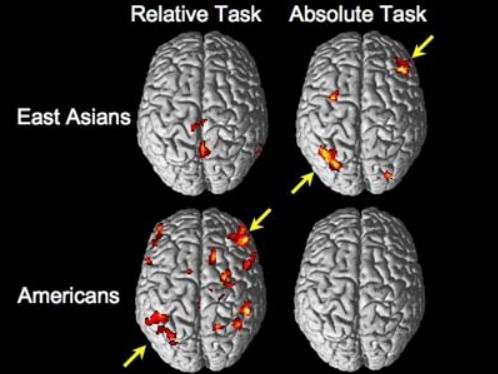 Varied brain activity is shown by East Asians and Americans as they make relative and absolute judgements, according to a study by MIT researchers. Americans tend to view objects individually rather than comparing them with surrounding objects. Hence, the arrows point toward an elevated intensity of brain activity in their brains while doing relative tasks (tasks that require analysis and comparison of different stimuli), which they do less frequently. This is the opposite for East Asians.
Source: https://news.mit.edu/2008/psychology-0111
2. Social Connection and Speech
Kinship structures, social hierarchies, and rituals regulate bonding and empathy — showing how culture configures neural-social circuits. The varied emphasis on self and group is also tied to the way they tend to express their emotions. While the amygdala is more active in the case of Westerners, as they speak more openly,
Asians tend to hold restraint with greater prefrontal inhibition. Additionally, Asian languages tend to be more tonal, prompting the use of both hemispheres for speech. Non-tonal speakers tend to utilize the left hemisphere more. As time passes, though, people are getting exposed to different cultures and choosing to adopt what resonates with them. Self-expression is increasingly influencing social connections.
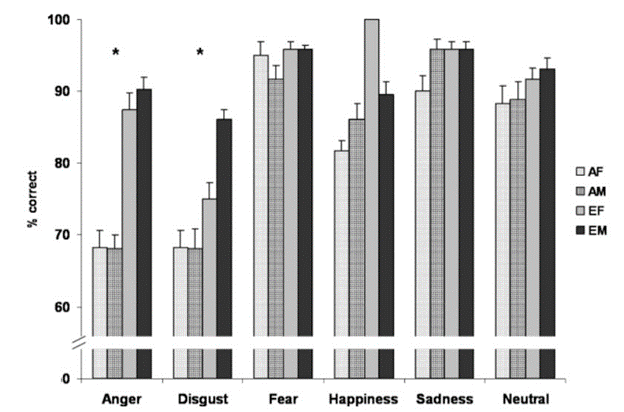
Graph from a study (explicit emotion recognition task), showing the emotional accuracy among Asians and Europeans. As Europeans (EM and EF) tend to express their ideas more freely, greater development of the amygdala (the central emotional processing hub) and subsequent accuracy is observed when compared with that of Asians (AM and AF). Source: https://bmcneurosci.biomedcentral.com/articles/10.1186/1471-2202-13-54
3. Motivation & Reward
What’s “rewarding” is culturally defined — e.g., competition vs. cooperation. Culture shapes what activates dopamine pathways (social approval, spiritual experience, achievement). Dopaminergic circuits—central to motivation and pleasure—respond to whatever a society deems valuable. In Western, individualistic contexts, activities that affirm personal achievement, autonomy, and competition tend to activate reward pathways most strongly. In contrast, in East Asian collectivistic settings, social harmony, cooperation, and group success elicit comparable neural responses. Culture, therefore, shapes the very cues that release dopamine, wiring the brain to find satisfaction in either standing out or fitting in.
4. Belief & Expectation
Religious faith, ritual healing, or cultural placebo effects show how shared belief systems can physically alter pain, stress, and immune responses. In Western contexts, religious and placebo responses often engage prefrontal–striatal circuits linked to personal agency and goal-directed belief, emphasizing individual control over outcomes. A common example of this is the supposed effect of Christian prayer practices on healing. Believers who pray often report reduced pain and suffering or faster recovery. This can be linked with the increased amount of endorphins being released, along with parasympathetic activation and reduced cortisol levels. A similar effect of induced calmness is observed with placebo medication. In many East Asian settings, collective rituals and interdependent belief frameworks preferentially recruit the anterior cingulate cortex (ACC) and insula, regions associated with empathy, social synchrony, and contextual emotion. Chanting of mantras, an essential part of Hindu poojas, for example, is shown to have reduced perceived pain or distress. Neuroimaging links these effects to increased alpha and theta oscillations in the cortex, enhancing relaxation and neuroplastic balance.
EFFECT OF VARIOUS EMBODIED PRACTICES ON NEUROPLASTICITY
“A healthy mind resides in a healthy body”. Just like how mental constructs make or break one's perspectives, mindset, and neuroplasticity, embodied practices like dance, music, forms of fine arts, sports, or even just movement bring about substantial changes in the brain's functioning. Here, we take a look at the activity of dance specifically.
According to a 2003 study in the New England Journal of Medicine by researchers at the Albert Einstein College of Medicine, who looked at the effects of 11 different types of physical activity, including cycling, golf, swimming, and tennis, only one of the activities—dance—lowered participants’ risk of dementia, since dancing involves a mental effort, physical coordination, and social interaction.
Moreover, dancing increases serotonin and dopamine secretion, which are hormones that help in long-term memory and spatial recognition. This reduces stiffness. Consequently, stress and tremors are reduced, and balance and coordination are maintained. This, in turn, helps develop new neural connections, especially in regions involved in executive function. Hence, dance is proven to have the ability to treat Parkinson's disease as well.
In a small study undertaken in 2012, researchers at North Dakota’s Minot State University found that the Latin-style dance program, known as Zumba, improves mood and certain cognitive skills, such as visual recognition and decision-making. Neurological Basis:
Music stimulates the brain’s reward centers, while dance activates its sensory and motor circuits. The following regions of the brain get activated while dancing: motor cortex [voluntary movement], somatosensory cortex [hand-eye coordination], basal ganglia, and cerebellum [integrates brain and spinal cord inputs and plans fine and complex actions]. Rhythmic auditory simulation (RAS) is thus used as therapy.
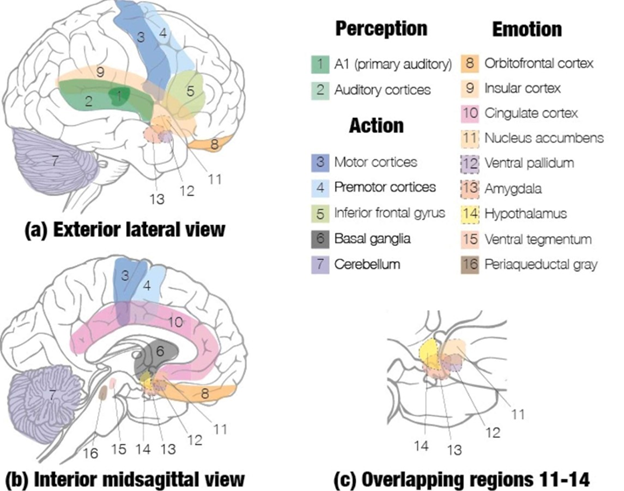
Image showing regions of the brain that get activated and develop with the help of dance. This diagram maps human brain anatomy by categorizing specific regions into three primary functions: Perception (green auditory areas), Action (blue/grey motor cortices and cerebellum), and Emotion (warm-colored limbic structures like the amygdala). Through three distinct perspectives—an exterior lateral view, an interior cross-section, and a detailed close-up—it illustrates the spatial relationships between these functional areas, highlighting both surface cortical regions and deep subcortical structures. Source: https://www.sciencedirect.com/science/article/pii/S0149763423001665
When gauging the influence that activities like dance have had on the brain, it was observed that it varied not only based on the mindset that people had in general, but also on the way dance was viewed in each culture. In countries like India and several African countries, where dance is the centerpiece of religious and spiritual ceremonies, there is a release of oxytocin and extensive sensorimotor integration and prefrontal coherence. In restrictive and conservative cultures, however, dance takes a form of reward or defiance, as a form of self-expression against the norm, propelling dopaminergic reward circuits and anterior cingulate cortex--regions involved in resisting inhibition.
Therefore, dance is proven to be a positive stimulant in neuroplasticity as well as neuroanthropology.
CONCLUSION:
On the whole, this article has traced the impact of various activities, practices, and constructs on the human brain’s neuroplasticity. We have observed the differences in the perception among different ethnic and cultural groups, and how mental as well as physical stimulation drives the plasticity of the brain. Through this article, we have illuminated that culture plays a big role in this. Hence, neuroscience and anthropology are interrelated. The brain is a complex and ever-evolving neural network, thus making it a plastic organ, driven by neuroanthropology.
References:
-
Basso JC, Satyal MK, Rugh R. Dance on the Brain: Enhancing Intra- and Inter-Brain Synchrony. Front Hum Neurosci. 2021 Jan 7;14:584312. doi: https://doi.org/10.3389/fnhum.2020.584312. PMID: 33505255; PMCID: PMC7832346.
-
Zeng H. Neural Correlates of Growth Mindset: A Scoping Review of Brain-Based Evidence. Brain Sci. 2025 Feb 14;15(2):200. doi: https://doi.org/10.3390/brainsci15020200.%20PMID:%2040002532;%20PMCID:%20PMC11852640
-
Argyriadis A, Palantzas T, Vlachadi M, Argyriadi A. Effect of Dance on Holistic Development of Culturally Diverse Communities. International Journal of Arts, Social Sciences & Humanities Studies. 2022;133–141.
-
Parsamanesh P, Vysochyn M. A Psychological Exploration of the Power of Our Mindset and Its Influence on Physiological Health. Cureus. 2024 Jan 18;16(1):e52505. doi: https://doi.org/10.7759/cureus.52505.PMID:38371054;PMCID:PMC10874242.
-
Seymour J, Mathers N. Placebo stimulates neuroplasticity in depression: implications for clinical practice and research. Front Psychiatry. 2024 Jan 10;14:1301143. doi: https://doi.org/10.3389/fpsyt.2023.1301143.PMID:38268561;PMCID:PMC10806142.
-
Park DC, Huang CM. Culture Wires the Brain: A Cognitive Neuroscience Perspective. Perspect Psychol Sci. 2010 Jul;5(4):391-400. doi: https://doi.org/10.1177/1745691610374591. PMID: 22866061; PMCID: PMC3409833.
-
Puderbaugh M, Emmady PD. Neuroplasticity. In: StatPearls [Internet]. Treasure Island (FL): StatPearls Publishing; 2025 Jan–. Updated 2023 May 01. Bookshelf ID: NBK557811.
-
Harvard Medical School. Dancing and the Brain. Winter 2015. In: Harvard Medical School “Brain” publications archive. Available from: https://hms.harvard.edu/news-events/publications-archive/brain/dancing-brain
-
Pascual-Leone A, Nguyet D, Cohen LG, Brasil-Neto JP, Cammarota A, Hallett M. Modulation of muscle responses evoked by transcranial magnetic stimulation during the acquisition of new fine motor skills. J Neurophysiol. 1995 Sep;74(3):1037-45.